
0 to 1: Designing a Smarter Way
to Transfer Aviation Assets
B2B Enterprise SaaS Platform
Imagine trying to transfer ownership of an aircraft or its components along with thousands of related documents using only emails, spreadsheets, and stacks of paper.
For many aviation companies, that’s still the reality. It’s a process vulnerable to lost data, miscommunication, and costly mistakes.
Our goal was to make asset data transfers simple and reliable. Give users a single place to manage transfers, ensuring nothing gets lost along the way.
Year
2025
Team
2 Product Designers
4 Developers
1 Project Manager
2 Business Analytics
1 Quality Assurance
Project Type
Solution 0 to 1
KEY RESULTS
Transformed asset transfers into a faster, more reliable process.
We streamlined asset transfers by reducing manual work, minimizing errors, and improving traceability and compliance.

40% ↓
Data entry time with bulk upload templates
35% ↓
Data entry errors
100%
Immutable and auditable records through blockchain integration
MY ROLE
I shaped the design solution, aligned teams, and assessed its effectiveness.
As the Product Designer, I owned the UX strategy - translating complex aviation requirements into clear, intuitive workflows. I partnered with analysts, engineers, QA, and leadership to align teams, balance business goals with user needs, design scalable solutions within technical constraints, and measure the impact of the workflow changes.

DEFINING REQUIREMENTS
I worked with the team to define requirements and integrate the new module.
Building this feature started with defining clear requirements. Over two weeks, we worked with Business Analytics to refine scenarios and align with existing systems. It quickly became clear we weren’t building a standalone feature, but a new module that had to fit seamlessly into the core platform - bringing added complexity around data security, permissions, and system consistency.

KEY AREAS

Data Privacy & Sharing
Asset transfers involve sensitive data, so controlling access and visibility was critical. We designed role-based permissions to securely share or restrict data without compromising organizational privacy.
Example: If a transfer request involved confidential documents, we had to define granular permissions for who could view, approve, or reject access to that data.
.png)
Handling Transfers for Connected Assets
A key challenge was maintaining linked data integrity for parent-child assets, like aircraft and their installed parts. (e.g., engines, landing gear)
Example: If the main asset (Aircraft) is transferred, how do we handle the transfer of installed parts? Should they be included in the request, or handled separately? We worked closely with engineers and data architects to define a consistent, reliable approach.

Designing with Blockchain in Mind
Block Aero operates on blockchain infrastructure, which inherently affects how asset data is recorded, updated, and verified.
We had to consider how the transfer process would maintain data immutability, ensure transaction traceability, and prevent unauthorized modifications to asset records.

PERSONAS


INTEGRATION POINTS
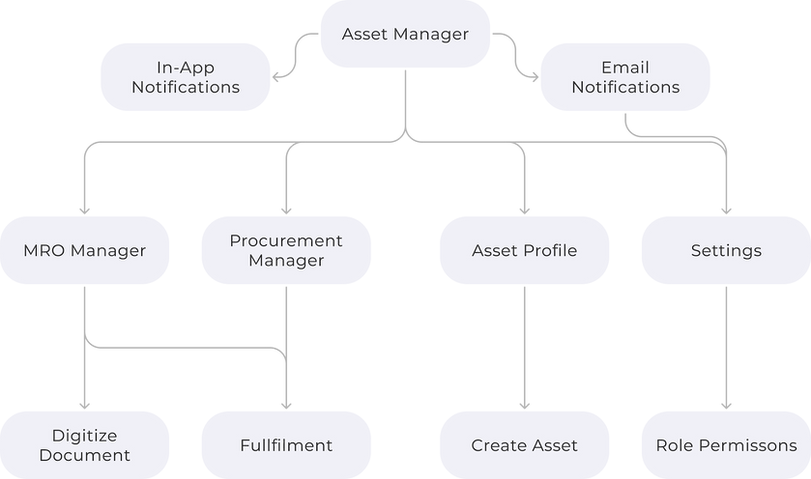
We identified how the new feature connects to existing platform workflows.
Next, we mapped all affected flows across the platform, pinpointing integration points with existing features like asset configuration, document management, and notifications.
FLOWCHARTS
We visualized user flows to uncover blockers and define the foundation for the feature.
We mapped flowcharts and user journeys to spot friction points and improvement areas. This revealed blockers, gaps in requirements, and helped shape the first version of the user journey. While the flows would later evolve, the core foundation of the feature was laid during this phase.
Identifying user needs led to clear design opportunities:

DESIGNING FOR COMPLEXITY & SCALABILITY
To design a scalable solution, I broke down transfer flows by understanding who initiates the process and their needs.
Designing the Asset Transfer MVP meant finding the right balance between complexity and scalability. We mapped out key flows without overengineering edge cases, leaving space for future improvements based on real user feedback.
I started by asking a simple question: Who is initiating the transfer, and why?
This helped us break the process down into three clear scenarios:

MVP SCENARIOS
We prioritized the MVP by grouping scenarios by risk, frequency, and impact, focusing on the most critical flows first.
We also found that owners typically initiate transfers, which helps centralize control and minimize data discrepancies. To prevent misuse, we proposed a flagging feature as a future enhancement, to be introduced only if needed based on user feedback.
High-Risk Scenarios – Parent Asset with All Installed Parts
-
Full aircraft transfer including child components (engines, avionics, etc.)
-
High data volume + document dependencies.
-
Design challenge: System Performance vs. data completeness
Common Scenarios – Parts-Only Transfers
-
Frequent selling/leasing of individual parts.
-
Simpler (no hierarchy), but still requires robust bulk operations.
-
Design Challenge: Build flexible columns, filters, and sorting to surface actionable transfers while hiding irrelevant public data.
Less Likely Scenarios – Partial or Multi-Party Transfers
-
Dividing assets among multiple organizations or conflicting role holders.
-
Complex approvals, edge case not included in MVP.
-
Design Challenge: Conflict management, parallel approvals.
SOLUTION ONE
Clear separation of actionable requests to reduce cognitive overload.
-
Users can filter Transfer Requests to only those requiring action from their organization, reducing noise in shared data.
-
“My Pending Action” highlights approvals or executions needed, improving visibility for complex flows.
-
Installed asset configuration provides context for parts-only transfers, while unique Transfer Batch IDs group related transfers — essential for high-risk, bulk operations.

SOLUTION TWO
Designed for clarity, control, and reduced approval friction.
-
Full overview of transfer details, roles, organizations, and document status — solving visibility gaps in Recipient-initiated flows.
-
Inline document list enhances traceability, essential for high-risk transfers with large document sets.
-
Related Transfer Requests panel groups connected transfers for easier management.
-
Status indicators show real-time progress, reducing uncertainty during multi-party approvals.

SOLUTION THREE
Clear connection between asset data and transfer initiation
-
Direct transfer initiation from the Asset Details page reduces steps and user errors.
-
Linked view of all related transfer requests ensures full visibility of processes.
-
Real-time logistics map provides up-to-date asset location and condition data, supporting informed decisions.

KEY TAKEAWAYS
1. Driving Operational Efficiency
The new Asset Transfer module reduces manual effort and approval delays, directly supporting faster deal cycles and improved operational throughput.
2. Enhancing Product Scalability
By architecting a modular system, we built a foundation that can easily expand to future workflows from leasing to teardown without redesigning the core logic.
3. Strengthening Market Position
Delivering a blockchain-backed, auditable transfer process differentiates Block Aero as a trusted digital infrastructure provider for aviation asset management.
4. Designing for Complexity at Scale
Balancing high-risk scenarios (full aircraft transfers) with common ones (parts-only) required clear prioritization — solving the most critical flows first while leaving room for scalability.
5. Simplifying User Experience
By introducing bulk uploads, clear transfer requests, and integrated document visibility, we turned a fragmented manual process into one streamlined, guided workflow.
LEARNINGS
We turned constraints into practical design decisions.
Working within constraints means staying practical and confident - sometimes making informed design decisions even without perfect data.

The Reality
Aviation Startup Environment
-
Limited resources
-
No capacity for full-scale user research
-
Need for fast, pragmatic decisions
The Outcome
What This Enabled
-
Real-world aviation alignment
-
Informed design decisions
-
Balanced business + technical realities
Our Approach
How We Adapted
- Tapped into industry expertise
-
Collaborated with internal stakeholders
-
Relied on professional intuition


.png)